
Have you ever noticed how some leaders can calm a tense meeting with a few words while others only make things more tense, even when they have similar technical skills?
40. How Does EQ Impact Leadership And Team Dynamics?
Emotional intelligence (EQ) is the often-overlooked skill set that shapes how you lead, influence, and create an environment where people want to contribute. In this article you’ll learn what EQ is, why it matters in leadership and teams, how it changes behaviors and outcomes, and practical steps you can take to raise EQ in yourself and your organization.
What is Emotional Intelligence (EQ)?
Emotional intelligence is your ability to recognize, understand, manage, and use emotions effectively — both your own and those of others. It combines self-awareness, self-regulation, social awareness, and relationship management into a set of skills that guide how you respond to people and situations.
You’ll find that EQ is not fixed; you can develop it over time with deliberate practice and reflection.
Core components of EQ
EQ typically breaks down into a few core components: self-awareness, self-management, social awareness, and relationship management. Each component contributes to how you perceive and influence emotions in workplace contexts.
These components form the basis for behaviors like empathy, conflict resolution, and motivational leadership.
Why EQ Matters in Leadership
EQ influences your credibility and trustworthiness
When you can name and manage your emotions, you show consistency and authenticity, which builds trust. People follow leaders they believe are steady and truthful about their intentions.
Trust accelerates cooperation, reduces friction, and fosters a willingness to take risks on behalf of the team.
EQ shapes your decision-making under pressure
High EQ helps you stay calm and think clearly when stakes are high. You’ll be better at balancing emotion and reason, avoiding impulsive decisions driven only by stress or ego.
That steadiness produces higher-quality decisions and more consistent outcomes.
EQ drives your ability to inspire and motivate
Rational arguments explain; emotions compel. Leaders with strong EQ can tap into their team’s values and aspirations, creating motivation that sustains effort through setbacks.
You’ll see better engagement and discretionary effort when motivation is grounded in emotional resonance.
Purchase The Emotional Intelligence For Leaders Course
How EQ Impacts Team Dynamics
Communication becomes more effective
When you understand emotional cues, you can tailor your messages so they’re received rather than misunderstood. That reduces miscommunication, clarifies expectations, and improves collaboration.
Teams with strong EQ norms are more likely to have productive conversations that solve problems rather than escalate them.
Conflict becomes constructive
High-EQ leaders and teams treat conflict as a source of information rather than a threat. You’ll notice disagreements becoming structured dialogues aimed at solutions instead of personal attacks.
That approach preserves relationships while improving outcomes.
Psychological safety increases
Emotional intelligence helps you create environments where people feel safe to speak up, share ideas, and admit mistakes. Psychological safety is the foundation for learning, innovation, and resilience.
When people feel safe, you get more honest feedback and better-quality work.
EQ vs IQ: What’s the difference and why both matter
Differences in function
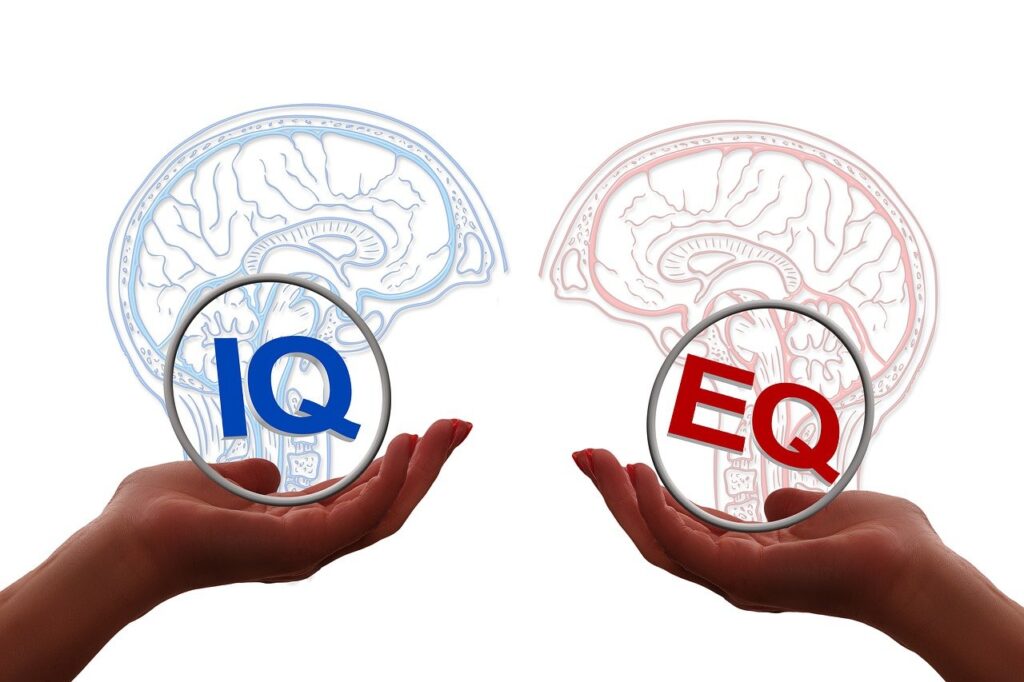
IQ reflects cognitive abilities like problem-solving and technical reasoning, while EQ governs how you manage emotions and relationships. Both are important, but they play different roles in leadership performance.
You’ll want to cultivate both: IQ helps you know what to do; EQ helps you get others to do it with you.
How they interact in leadership
High IQ without EQ can result in brilliant strategies that fail due to poor execution or disengaged teams. Conversely, high EQ with moderate IQ can produce collaborative cultures and sustained performance even when technical skill gaps exist.
Balancing the two gives you the best chance for consistent results.
Specific leadership behaviors influenced by EQ
Active listening and presence
EQ trains you to listen beyond words — to tone, pacing, and body language. That makes people feel heard and valued, and it gives you richer information for decisions.
Being present also models the behavior you want in the team.
Empathy and perspective-taking
You’ll be able to see problems from other people’s viewpoints, which helps in negotiation, conflict resolution, and coaching. Empathy reduces friction and opens paths to compromise.
Empathy doesn’t mean agreement; it means understanding.
Emotional regulation and composure
Your ability to regulate stress and manage impulses prevents emotionally driven reactions that can damage trust. Composure under pressure reassures your team and maintains focus.
You’ll be more effective in crisis situations when you can hold your own emotions steady.
Feedback delivery and coaching
Leaders with high EQ frame feedback in ways that are specific, compassionate, and actionable. That increases the likelihood of behavior change and growth.
You’ll also be better at recognizing when someone needs encouragement versus corrective feedback.
How EQ impacts organizational outcomes
Employee engagement and retention
Teams led by emotionally intelligent managers typically report higher engagement and lower turnover. You’ll find that people stay when they feel respected and understood.
That reduces recruitment cost and preserves institutional knowledge.
Team performance and productivity
EQ improves collaboration, communication, and motivation — all contributors to productivity. Teams experience fewer derailments and more consistent performance.
You’ll see fewer rework cycles and higher throughput when emotional dynamics are healthy.
Innovation and adaptability
Psychologically safe teams take more intellectual risks and learn faster from failures. EQ fosters the adaptive mindset that organizations need in rapidly changing environments.
You’ll be better prepared to pivot successfully when you cultivate those capabilities.

EQ and conflict resolution: a deeper look
Transforming conflict into productive outcomes
When you apply EQ, conflict becomes a tool for understanding gaps in assumptions and goals. You can guide teams to surface underlying interests and pursue integrative solutions.
That approach helps you resolve recurring problems rather than masking them.
Practical steps to resolve conflict using EQ
- Stay calm and model regulated behavior.
- Facilitate expression of perspectives without judgment.
- Summarize and reflect to ensure understanding.
- Move from positions to underlying interests.
- Co-create action steps and follow up.
Using these steps, you’ll be able to transform emotional energy into collaborative problem-solving.
EQ in hiring and promotion decisions
Assessing EQ during recruitment
You can include behavioral interview questions, simulations, and reference checks focused on emotional competencies. Look for evidence of self-awareness, empathy, and conflict management.
Hiring for EQ complements technical skill assessments and reduces risk of cultural mismatch.
Developing leaders internally
Promoting someone with strong EQ sets a cultural example. If technical competency is high but EQ is low, consider targeted development before promotion.
You’ll get better long-term performance if promotion decisions consider both skill and emotional capability.

Measuring EQ: tools and indicators
Formal assessments and 360 feedback
There are validated assessments and 360-degree reviews that measure competencies related to EQ. These instruments give you structured data on strengths and gaps.
Use them as part of a broader development plan rather than a single-point judgement.
Behavioral indicators to watch for
- Ability to accept feedback without defensiveness
- Calm problem-solving under pressure
- Empathetic responses to others’ concerns
- Consistent follow-through on commitments
These observable behaviors give you ongoing, actionable insight into EQ in real work contexts.
Table: High EQ vs Low EQ behaviors in leaders
| Dimension | High EQ Behaviors | Low EQ Behaviors |
|---|---|---|
| Self-awareness | Acknowledges mistakes; seeks feedback | Blames others; defensive |
| Self-regulation | Stays calm under stress; thinks before acting | Explosive reactions; impulsive decisions |
| Empathy | Listens actively; validates feelings | Dismisses others’ concerns; lacks curiosity |
| Communication | Clarifies intent; adapts message | One-way directives; vague expectations |
| Conflict handling | Addresses issues constructively | Avoids conflict or escalates it |
| Motivation | Inspires through meaning and purpose | Relies on authority or incentives only |
This table helps you diagnose patterns and prioritize where to intervene.

Building EQ in yourself: practical practices
Practice self-awareness daily
Spend a few minutes each day reflecting on emotional triggers and responses. Journaling short, specific notes helps you see patterns.
You’ll notice recurring themes and can choose different responses over time.
Use breath and pause to regulate emotions
When you feel a strong reaction, use simple breath counts (e.g., inhale 4, hold 4, exhale 6) to create a pause. That pause increases the chance of a thoughtful response.
This small habit prevents reactive behavior in crucial moments.
Seek feedback and act on it
Ask trusted colleagues for candid feedback about how your behavior impacts others. Treat it as data, not judgment.
Acting on feedback demonstrates humility and commitment to growth.
Practice perspective-taking
Before responding in tough conversations, deliberately consider the other person’s possible feelings and needs. Frame responses that acknowledge those factors.
You’ll improve relationships and reduce misunderstandings.
Developing EQ across a team or organization
Leadership modeling and expectations
Your behavior sets the tone. When you model emotional intelligence — admitting mistakes, asking for input, and handling stress constructively — others follow.
Create explicit norms that reward collaborative and emotionally savvy behavior.
Training and coaching programs
Structured programs can teach skills like active listening, nonviolent communication, and stress management. Coaching helps leaders apply these skills in real situations.
Combining group learning with one-on-one coaching accelerates transfer to daily work.
Rituals and practices that reinforce EQ
Introduce team check-ins that include emotional state sharing, retrospective formats that focus on feelings and learnings, and recognition routines that highlight relational contributions.
These rituals make emotional skills visible and habitual.
Table: EQ development techniques and expected impact
| Technique | What you practice | Expected short-term impact | Expected long-term impact |
|---|---|---|---|
| Daily reflection | Self-awareness | Clearer view of triggers | Improved self-regulation |
| Role-playing | Difficult conversations | Reduced anxiety in practice | Better conflict outcomes |
| 360 feedback + coaching | Perspective on others’ views | Insight into blind spots | Sustained behavior change |
| Mindfulness practices | Emotional regulation | Short-term calm | Greater resilience |
| Team norms | Communication expectations | More predictable interactions | Culture of trust |
Use this table to design a mixed-method development plan for yourself and your teams.
EQ and remote/hybrid work dynamics
Reading emotions at a distance
You’ll rely more on tone, content, timing, and written cues when in remote settings. High EQ helps you pick up subtleties in messages and respond with empathy.
Intentional communication replaces incidental hallway interactions.
Rituals to maintain psychological safety remotely
Regular one-on-ones, check-in questions that include well-being, and clear norms for asynchronous communication preserve safety and connection.
You’ll need redundancy in communication to avoid misinterpretation.
Case examples: EQ in action
Example 1 — Turning around a low-trust team
Imagine a team where people avoid admitting mistakes. A manager starts holding weekly learning sessions where mistakes are discussed constructively and the manager models vulnerability by sharing their own missteps. Over months, reporting of risks increases, collaboration improves, and delivery reliability rises.
This scenario shows how EQ shapes culture through consistent behavioral choices.
Example 2 — Managing a high-stakes conflict
Two senior contributors are in a public disagreement about direction. You facilitate a mediated conversation where each shares emotions and interests while you reflect and reframe. The conflict shifts from personal criticism to a joint problem-solving session, producing an integrated approach.
Here, EQ skills defuse escalation and turn energy toward solutions.
Common challenges and pitfalls when developing EQ
Confusing empathy with agreement
Empathy does not require you to agree with someone’s position. Its purpose is to understand and validate emotional experience so you can respond productively.
You’ll maintain clarity about decisions while still acknowledging people’s feelings.
Superficial programs without practice
Sending people to a workshop without follow-up leads to little behavioral change. EQ requires practice, feedback, and reinforcement.
Plan for ongoing coaching and integration activities.
Ignoring systemic issues
Sometimes emotional problems are symptoms of structural issues like unclear roles, unrealistic workload, or unfair policies. EQ won’t fix those alone; you must pair emotional skills with systemic change.
You’ll be more effective if you use EQ diagnostically to uncover root causes.
Metrics and KPIs to track EQ-related progress
Qualitative and quantitative measures
You can use engagement scores, turnover rates, 360 feedback improvement, conflict incidence, and project delivery reliability as indicators. Qualitative stories and anonymized comments are equally valuable.
Track a mix of measures to see both behavior change and business impact.
Sample KPI set
- Employee engagement score (target increase X%)
- Voluntary turnover rate (target decrease Y%)
- 360 feedback scores on empathy and communication (target increase Z)
- Number of escalated interpersonal conflicts (target decrease)
These KPIs link EQ development to tangible outcomes.
Tools and frameworks to support EQ work
Popular assessment tools
There are validated instruments that measure emotional competencies and workplace behavior. Use them for baseline and progress tracking.
Select tools with good psychometric properties and organizational relevance.
Frameworks for conversations
Adopt structured approaches like Nonviolent Communication (NVC) or radical candor as shared language for feedback and conflict. These frameworks reduce ambiguity and normalize emotional literacy.
You’ll find conversations become less threatening when everyone knows the process.
Sustaining EQ improvements over time
Embed EQ into performance systems
Include emotional competencies in role expectations, performance reviews, and reward systems. Recognition that values relational skills signals their strategic importance.
You’ll see more consistent practice when incentives align.
Make reflection and feedback routine
Schedule regular reflection moments, peer feedback, and coaching checkpoints. Continuous feedback prevents regression to old habits.
Small, steady steps create lasting change.
Frequently asked questions (brief)
Can EQ be taught to everyone?
Yes, to varying degrees. Some people learn faster, but everyone can improve with intentional practice, feedback, and supportive environments.
You’ll benefit most from a personalized mix of training, coaching, and real-world application.
Is EQ more important for senior leaders than for individual contributors?
It’s important at every level, but the impact scales with role. Senior leaders influence culture and systems, so their EQ has cascading effects across the organization.
You’ll still need strong EQ in frontline roles for effective teamwork and customer interaction.
How long does it take to see change?
You can see initial changes in weeks with focused practice, but sustained transformation often takes months to years. Regular reinforcement accelerates progress.
Don’t expect a single workshop to be enough.
Actionable checklist to improve EQ in your leadership and teams
- Start a daily reflection habit: 5–10 minutes journaling about emotional triggers and responses.
- Use one structured feedback tool (360 or peer feedback) and commit to follow-up coaching.
- Introduce team rituals for psychological safety: weekly check-ins, post-mortems that emphasize learning.
- Model vulnerability: share one learning or mistake each month.
- Teach and practice active listening in meetings: summarizing, reflecting feelings, asking clarifying questions.
- Implement breathing or brief mindfulness moments before high-stakes meetings.
- Include emotional competencies in role descriptions and performance reviews.
- Track relevant metrics (engagement, turnover, 360 results) quarterly and adjust plans accordingly.
This checklist gives you concrete starting points you can implement now.
Final thoughts
Emotional intelligence is the lever that multiplies your technical skills into durable leadership and productive team dynamics. When you prioritize EQ, you don’t only improve individual interactions; you change the cultural fabric that determines how people collaborate, innovate, and persevere.
If you commit to learning and practicing EQ, you’ll notice clearer communication, stronger relationships, and better team performance — outcomes that compound over time.